
How to Tell If a Breaker Needs Replacement
Last Updated: November 25, 2026
Quick Summary
To know how to tell if a breaker needs replacement, watch for frequent tripping, a breaker that feels hot, a burning or fishy smell, buzzing or crackling, scorch marks, or a switch that won’t reset. Two or more symptoms together point to breaker failure, while a tripped breaker that resets and holds was likely just an overload.
- A breaker that trips again within days of resetting is a warning sign of failure.
- Warm is normal under load, but a breaker face that feels hot is not.
- If a breaker trips with nothing plugged in, stop and call an electrician.
- A tripped breaker recovers and stays on, while a bad breaker keeps failing.
- Do not remove the panel cover; leave panel access to a licensed electrician.
Table of Contents
- Bad Circuit Breaker Symptoms to Check First
- What to Do Immediately With Heat, Smoke, or a Burning Smell
- How to Tell If a Breaker Is Bad Without a Multimeter
- How to Test If a Breaker Is Overloaded
- Tripped Breaker vs. Bad Breaker: Comparing the Symptoms
- How an Electrician Confirms a Breaker Has Failed
- Circuit Breaker Replacement Cost and What Affects the Job
- Scheduling a Breaker Inspection With Dwello Home Services
- Frequently Asked Questions
Bad Circuit Breaker Symptoms to Check First
Knowing how to tell if a breaker needs replacement starts with spotting the warning signs early, and the first step is learning how to tell if a breaker needs replacement by watching for those signs. A breaker is a safety switch, and when it fails, it stops protecting your home. Watch for breakers that trip often, feel hot, smell like burning plastic, buzz, or show scorch marks. Any one of these means the breaker deserves a closer look before you reset it again.
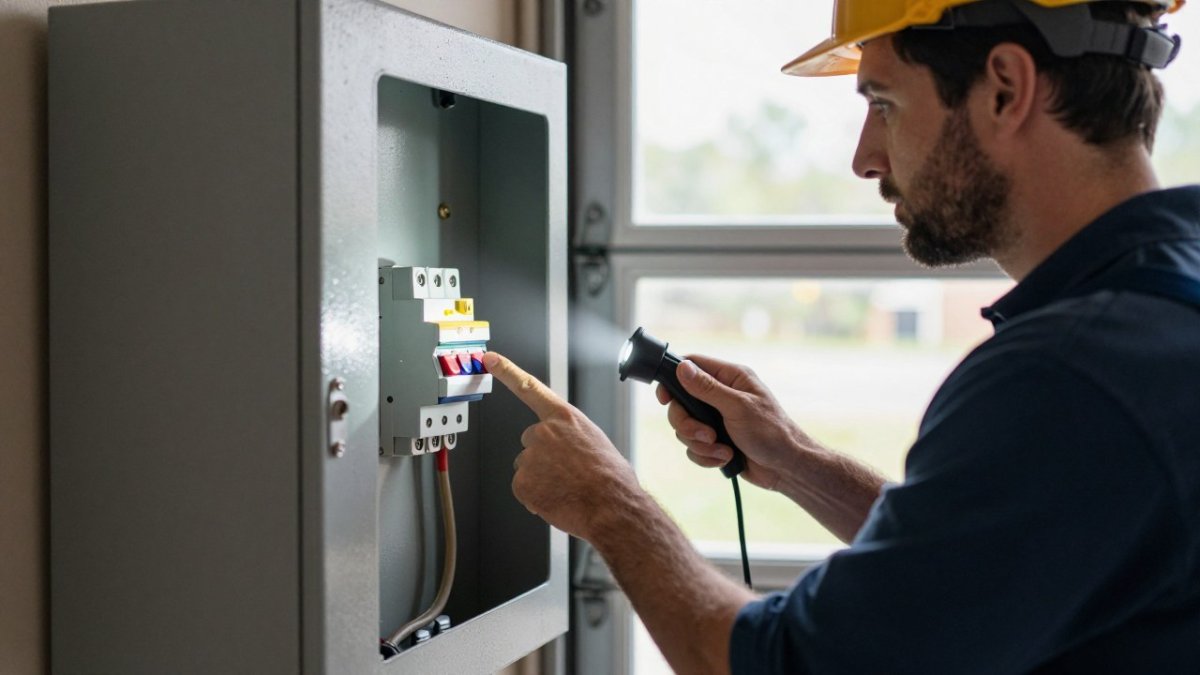
Here is the full checklist of bad circuit breaker symptoms:
- Frequent tripping: the same breaker trips again within days
- Heat: the breaker or panel cover feels hot to the touch
- Burning smell: a fishy or plastic odor near the panel
- Buzzing or crackling: unusual noise from inside the panel
- Won’t reset: the switch will not stay in the ON position
- Visible damage: scorch marks, brown discoloration, or melted plastic
- Damaged wiring: frayed wire or outlet damage near the circuit
One symptom alone can be a fluke. Two or more together point to breaker failure.
What to Do Immediately With Heat, Smoke, or a Burning Smell
Stop. Do not touch the panel if it is hot, smoking, or smells like burning. This is a fire risk, not a reset problem. Turn off power at the main breaker only if you can reach it safely without touching anything hot or wet. Then leave the area and call a licensed electrician right away.
A burning smell near an electrical panel often means overheating inside the panel itself. Never spray anything on it, never open the cover to look, and never reset the breaker to “see what happens.” The NFPA home electrical safety guidance is clear that damaged or overheating panels should be evaluated by a qualified professional.
If you see smoke or flames, get everyone out and call 911 first. Safety comes before diagnosis, every time.
How to Tell If a Breaker Is Bad Without a Multimeter
You can spot most bad breakers with your eyes and hands, no meter needed. This is the safe homeowner check.
- The reset test: flip the breaker fully OFF, then back ON. A healthy breaker clicks firmly and stays put. A bad one feels loose, won’t latch, or trips again right away.
- The touch test: with a light touch, check the breaker face. Warm is normal under load. Hot is not.
- The look test: shine a light on the breaker. Look for scorch marks, brown discoloration, or melted plastic.
- The listen test: a faint hum is fine. Buzzing, sizzling, or crackling is a warning sign.
- The pattern test: note which breaker trips and when. Same breaker, same time of day, points to a real fault.
Pattern matters. Write down what was running when a breaker tripped.
How to Test If a Breaker Is Overloaded
An overloaded circuit is not a bad breaker. It is a circuit carrying more electrical load than it was built for.
Step 1: Map the circuit before you touch anything. With the breaker ON and everything unplugged, turn on one device at a time and note which outlets and fixtures go dead when you flip the breaker OFF. Write the list down.
Step 2: Reset once, then observe. Flip the breaker fully OFF, then firmly ON. A healthy breaker clicks and holds.
Step 3: Add loads back one at a time. Plug in and turn on devices one by one, pausing at each.
Step 4: Isolate the appliance. Move the suspect device to a circuit on a different breaker. If it trips that breaker too, the appliance is faulty, not the breaker. If it runs fine elsewhere, the original circuit is overloaded.
Step 5: Do the math. Compare the wattage ratings on the device labels to the breaker’s amp rating. A single 1,500-watt space heater plus a 1,200-watt hair dryer on the same 15-amp circuit is already over the limit.
Common overload culprits:
- Space heaters and hair dryers on the same circuit
- A kitchen with too many appliances on one line
- An electrical range or oven sharing a circuit it shouldn’t
- Power strips daisy-chained into a single outlet
Stop conditions, call an electrician instead of continuing:
- The breaker trips with nothing plugged in
- The breaker or panel cover is hot to the touch
- You smell burning or see scorch marks or discoloration
- The breaker will not reset or feels loose
- You hear buzzing or crackling from inside the panel
What a homeowner can safely do: flip breakers, unplug devices, read labels, and note patterns. What requires an electrician: removing the panel cover, testing terminals, replacing a breaker, or investigating a circuit that trips with no load.
If the breaker trips with nothing plugged in, that points to wiring or the breaker itself. For more on preventing overload fires, see our guide on how to prevent electrical fires from overloaded circuits.
Tripped Breaker vs. Bad Breaker: Comparing the Symptoms
A tripped breaker is doing its job. A bad breaker has stopped doing its job. Here is how the symptoms compare side by side.
| Symptom | Tripped Breaker | Bad Breaker |
|---|---|---|
| Trips | Once, after a heavy load | Repeated trips, no clear cause |
| Reset | Resets and holds fine | Won’t reset or trips again fast |
| Temperature | Cool or slightly warm | Hot to the touch |
| Smell | None | Burning or fishy odor |
| Sound | Silent | Buzzing or crackling |
| Appearance | Clean, normal | Scorch marks, discoloration, melted plastic |
The key difference: a tripped breaker recovers and stays on. A bad breaker keeps failing. If you reset it and it holds for weeks, it was an overload. If it won’t hold at all, it needs replacement.
How an Electrician Confirms a Breaker Has Failed
An electrician confirms failure with tools and tests a homeowner should not attempt. This is where professional evaluation takes over.
The process usually includes:
- Voltage testing at the breaker terminals to confirm power in and out
- A load test to see if the breaker trips below its rated amps
- Thermal checks to find hot spots inside the panel
- A visual inspection of the bus bars, wiring, and connections
A breaker that trips below its rating has failed internally, even if it looks fine. The U.S. Consumer Product Safety Commission notes that electrical panel and breaker problems are a known fire hazard, which is why testing matters.
This is also where we check for a two-pole breaker or 40-amp breaker feeding a large appliance. Those fail differently and need the right replacement part.
Circuit Breaker Replacement Cost and What Affects the Job
Circuit breaker replacement cost depends on the breaker type, the panel, and the labor involved. Most homeowners want a realistic range before they call, so here is how the numbers break down, with the caveat that every panel is different and a quote should follow an on-site diagnosis.
Pricing depends on the breaker type, amp rating, panel condition, and whether a permit is required. For current pricing and a clear quote, see the Dwello Home Services pricing page.
What drives the cost up:
- Breaker type: standard, GFCI, AFCI, tandem, or double-pole, AFCI and GFCI breakers cost more than standard
- Amp rating: a 40-amp breaker for an oven costs more than a 15-amp
- Panel condition: scorch marks, damaged wiring, or corrosion add work
- Access: a crowded, hard-to-reach, or exterior panel takes longer
- Permits and inspection: panel work usually requires a permit; a single breaker swap often does not
- Upgrade needs: an aging panel may need a full upgrade, not one breaker
Replacement versus panel upgrade. Age alone does not prove a breaker has failed, but it does raise the question of whether the panel is worth investing in.
What a fair quote should include: the breaker make and model, the amp rating, whether a permit is required, the labor estimate, and a clear statement of what happens if the diagnosis turns up wiring damage behind the panel. A quote that skips the diagnosis is a red flag, a cheap breaker swap that leaves the real fault in place just moves the problem.
Watch out: if a contractor quotes a flat price before looking at the panel, or offers to skip the permit on panel work, walk away. Permitted, inspected work protects you at resale and with your insurer.
For current pricing, book circuit breaker replacement in Duncanville, TX and we will give you a clear quote with no hidden fees.
Scheduling a Breaker Inspection With Dwello Home Services
If any symptom on this list showed up in your panel, do not wait for it to fail completely. A breaker that is overheating or won’t reset is a safety hazard, and the fix is usually straightforward once we find the cause.
Dwello Home Services is a family-owned, fully licensed team serving homeowners across the DFW area. We handle electrical repairs and troubleshooting, panel work, and breaker replacement. Our technicians test the circuit, explain what failed, and give you clear options with fair pricing. No upsells, no guesswork.
Whether you are in Midlothian or Lewisville, we can schedule a breaker inspection and get your panel back to doing its job. Call us or book online and we will take it from there.
A breaker that trips once is a warning. A breaker that trips, heats up, or smells like burning is telling you it is done. Do not reset it and hope. Dwello Home Services sends licensed technicians who test the circuit, confirm the failure, and replace only what needs replacing, with clear pricing and no hidden fees. Get started with Dwello Home Services and put your home’s electrical safety back in reliable hands.
Frequently Asked Questions
How do I check to see if a breaker is bad?
Start by looking at the breaker itself. A breaker that will not stay in the reset position, feels hot, shows scorch marks or melted plastic, or smells like burning is a strong candidate for breaker replacement. Listen for buzzing from the panel and note whether the same circuit trips repeatedly even after you unplug everything on it. If any of these signs appear, stop resetting it and have a licensed electrician inspect the panel before using that circuit again.
Can a breaker keep tripping because it is faulty rather than overloaded?
Yes. Frequent tripping is the most common bad circuit breaker symptom, but it has two main causes. An overloaded circuit trips because too much electrical load is running at once, so unplugging appliances often stops it. A faulty breaker trips with little or nothing plugged in, or will not reset at all. If the trips continue after you clear the circuit, the breaker itself is the likely culprit and should be tested by an electrician.
How much does circuit breaker replacement cost?
Circuit breaker replacement cost depends on the breaker type, the panel, and labor in your area. A single standard breaker is usually the least expensive job, while GFCI, AFCI, tandem, and double-pole breakers cost more because of the parts and added testing. If the panel is old, damaged, or already full, an upgrade may be recommended instead. For current pricing, see the Dwello Home Services pricing page or request a quote.
What is the 80% rule for breakers?
The 80% rule means a breaker should carry no more than 80% of its rated load for continuous use. A 20-amp breaker, for example, should handle about 16 amps continuously. Exceeding that limit for long periods causes overheating, nuisance tripping, and eventually breaker failure. If your circuit trips whenever a heavy appliance runs, the load may simply be too high for the breaker, and a dedicated circuit or breaker upgrade may be the right fix.